A few years ago a friend of mine, a high school maths teacher, showed me two report cards from two different classes she had been teaching. Both classes had the same average score on the same test: 72 out of 100. By every official number the school cared about, the classes looked identical.
Then she showed me the actual scores. One class had everyone hovering between 68 and 76. The other class had a few students at 35 and a few at 98. Same average. Two completely different stories.
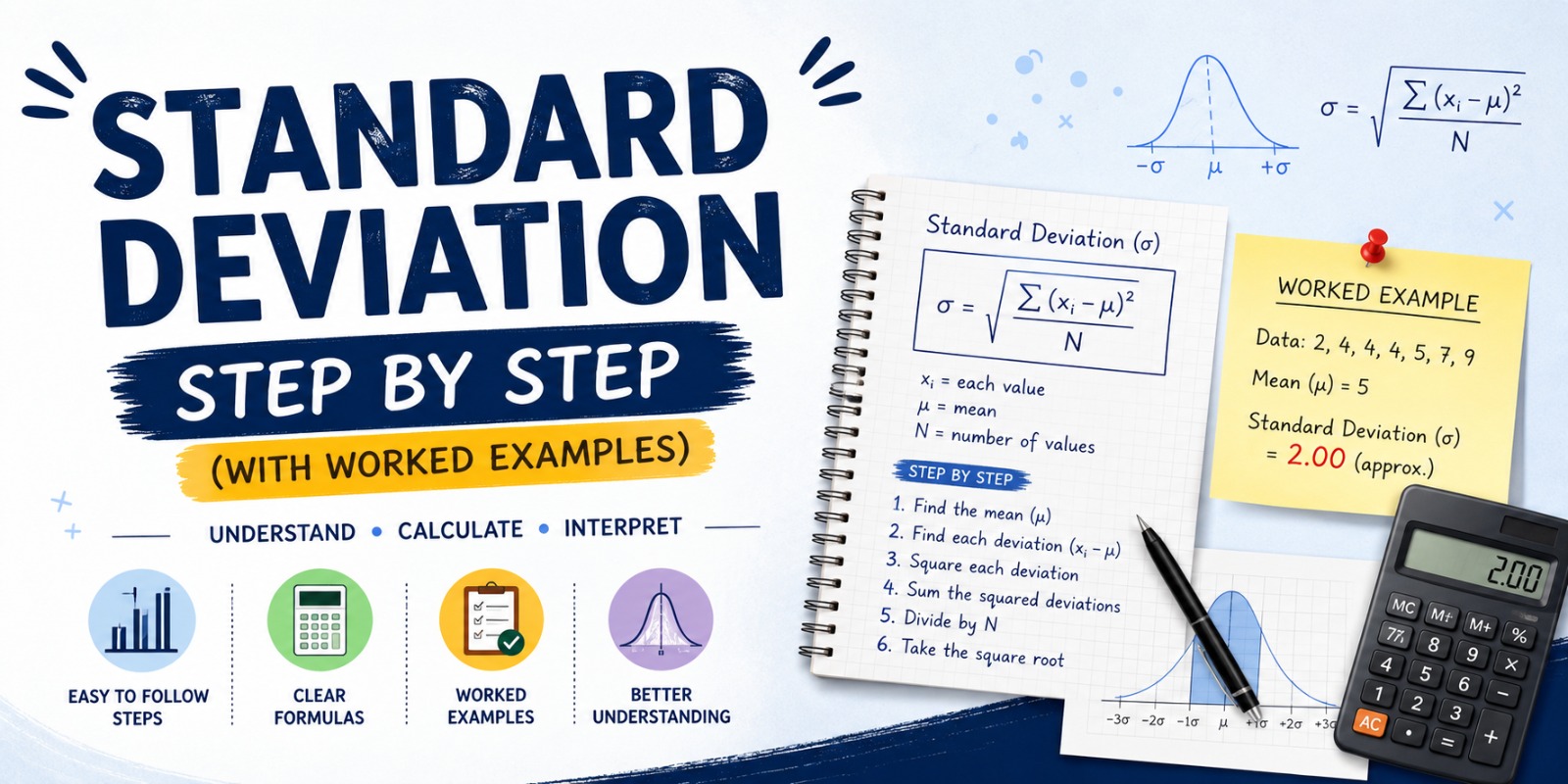
Standard deviation is the number that finally tells those two stories apart. It is one of the most useful ideas in statistics, and it is also one of the most over-complicated. So let us calculate it from scratch, with real numbers, and without any hand-waving.
Why averages lie about your data
The mean (or average) is a single point. It tells you where the middle of your data sits. What it does not tell you is whether your numbers are bunched tightly around that middle or scattered all over the place.
Picture two coffee shops. Both claim an average wait time of 5 minutes. At the first shop, every customer waits somewhere between 4 and 6 minutes. At the second, half the customers wait 1 minute and the other half wait 9. The signs at the door would say the same thing, but your experience as a customer would not be remotely the same.
“The mean tells you where the centre is. Standard deviation tells you how seriously to trust the centre.”
What standard deviation actually measures
Standard deviation answers a single question: on average, how far is a typical data point from the mean?
That is it. Strip away the Greek letters and the symbols, and the formula is just measuring distance. The complications are mostly bookkeeping: we square the distances to keep them positive, we average the squares, and we take a square root at the end to undo the squaring. Every step has a reason.
See the spread for yourself
Before any maths, get a feel for what we are measuring. Both datasets below have the same mean. The only thing that changes is how tightly the dots cluster around it.
Interactive
Both datasets have the same mean (50). Toggle to feel the spread that standard deviation actually measures.
The low-spread dataset has a standard deviation around 2. The high-spread one is closer to 22. Same average, eleven times more scatter. If a manager only looked at the average, those two situations would look the same. If they looked at the standard deviation, they would treat them very differently.
Population vs sample: the n vs n−1 trap
Before we touch a single number, we need to settle one decision that trips up almost everyone. There are two flavours of standard deviation, and they differ in one tiny place.
If you have data for every single item you care about (every employee in your company, every test paper in this exact class, every product made today), you have a population. You divide by .
If your data is a sample drawn from some larger population (a survey of 200 people meant to represent a city, a batch of products meant to represent a factory), you divide by instead.
Use when you have every value in the group you care about.
Use when your data is a sample from a larger group.
Rule of thumb: if you are not sure which one you have, you almost certainly have a sample. Real-world data is rarely complete. Use .
The five steps, in plain English
Every standard deviation calculation is the same five steps, in the same order. Once you have done it twice, it becomes muscle memory.
Find the mean
Subtract the mean from each value
Square every deviation
Average the squared deviations
Take the square root
Worked example 1: population SD
Let us calculate the standard deviation of five test scores. Imagine these are the scores of every student in a small study group, so this is the entire group we care about. That makes it a population.
Scores: 80, 82, 78, 85, 75
Step 1: Find the mean
The mean is 80. Now we measure how far each score sits from 80.
Step 2 to 4: Build a table
Doing this in a table is the single biggest thing that stops you making errors. Three columns: the value, its deviation from the mean, and the squared deviation.
Population SD worktable
| Score (x) | x − μ | (x − μ)² |
|---|---|---|
| 80 | 0 | 0 |
| 82 | 2 | 4 |
| 78 | −2 | 4 |
| 85 | 5 | 25 |
| 75 | −5 | 25 |
| Sum of squared deviations | 58 | |
Now divide that sum by to get the variance, and take the square root.
The population standard deviation is approximately 3.41. A typical student in this study group scored about 3.4 points away from the mean of 80. That gives the average a context that the average itself never could.
Worked example 2: sample SD
Now let us run a slightly bigger example as a sample, so we can see how the changes things.
Imagine you walk into a coffee shop on seven different mornings and time how long it takes to get your order. You are not capturing every morning ever, just seven of them as a sample.
Wait times (minutes): 4, 6, 5, 8, 7, 6, 5
Step 1: The sample mean
Step 2 to 4: Worktable
Sample SD worktable
| Wait (x) | x − x̄ | (x − x̄)² |
|---|---|---|
| 4 | −1.86 | 3.46 |
| 6 | 0.14 | 0.02 |
| 5 | −0.86 | 0.74 |
| 8 | 2.14 | 4.58 |
| 7 | 1.14 | 1.30 |
| 6 | 0.14 | 0.02 |
| 5 | −0.86 | 0.74 |
| Sum of squared deviations | 10.86 | |
Because this is a sample, we divide by , not by 7.
The sample standard deviation is roughly 1.35 minutes. On a typical morning, your wait time at this coffee shop sits about 1 minute and 20 seconds away from the average of just under 6 minutes. That is the kind of summary a manager can actually act on.
If you had treated this dataset as a population and divided by 7 instead of 6, you would have got 1.25 instead of 1.35. Close, but wrong. The smaller your dataset, the more this distinction matters.
Why on earth do we divide by n − 1?
This is the question every student asks, and most textbooks dodge. Here is the honest answer in two sentences.
When you calculate a sample mean from your data, you are already using the data once. That means the deviations from the sample mean are always slightly smaller than the deviations from the true population mean would have been.
Dividing by instead of is a tiny inflation factor that compensates for that bias. It is called Bessel's correction, and without it your sample standard deviation systematically underestimates the true population value. Statisticians do not love arbitrary fudge factors. They use this one because the maths genuinely demands it.
Where standard deviation shows up in real life
This is not a maths-class abstraction. Once you start looking, you see standard deviation hiding behind decisions in almost every industry. Here are four places where the average alone would mislead you, and the standard deviation tells the real story.
Two funds, same return, very different sleep
The 0.02mm that decides if a factory survives
Same average, completely different wardrobe
The clutch player problem
Notice the pattern. In every one of these examples, two situations share the exact same mean. If you compared them on the average alone, you would conclude they were equivalent. The standard deviation is what separates a reliable investment from a gamble, a working bolt from scrap metal, and a steady scorer from a streaky one.
Common mistakes that ruin the answer
Across years of marking, the same handful of slip-ups account for almost every wrong answer. Watch for these.
Skipping the squaring step
If you just add up the deviations without squaring them, they cancel out to zero every single time. That zero is meaningless, not a discovery.
Forgetting the square root
Stopping at the variance gives you a number in units squared (minutes squared, dollars squared) that nobody can interpret. The final square root puts you back in real units.
Using n when you needed n − 1
On small samples this throws your answer off noticeably. Always pause and ask: is this every value, or just a sample of values?
Rounding too early
If you round the mean to a whole number before computing deviations, tiny errors cascade through every row. Keep at least two extra decimals until the very last step.
When you do not actually need to do this by hand
Once you understand what each step is doing, you almost never need to crunch the numbers manually. Spreadsheets, statistical software, and calculators all do it instantly. The reason to do it by hand at least once is so you can spot when those tools are giving you the wrong flavour of answer (Excel's STDEV.P versus STDEV.S trips people up constantly).
Paste your numbers into our Standard Deviation Calculator and get both population and sample SD with the workings shown step by step. It is free and there is no signup.
Open the calculatorIf you found this useful, the same logic shows up in two other calculators worth bookmarking: the correlation coefficient calculator (which uses standard deviation internally) and the linear regression calculator. Both lean on the exact same ideas you just learned.
Frequently asked questions
What is the easiest way to remember the standard deviation formula?+
When should I divide by n and when by n−1?+
Is standard deviation the same as variance?+
Can standard deviation be negative?+
What does a standard deviation of zero mean?+
How big does the standard deviation need to be to matter?+
Do I need to memorize the formula for exams?+
Build your scatter plot in seconds - free, no signup.